
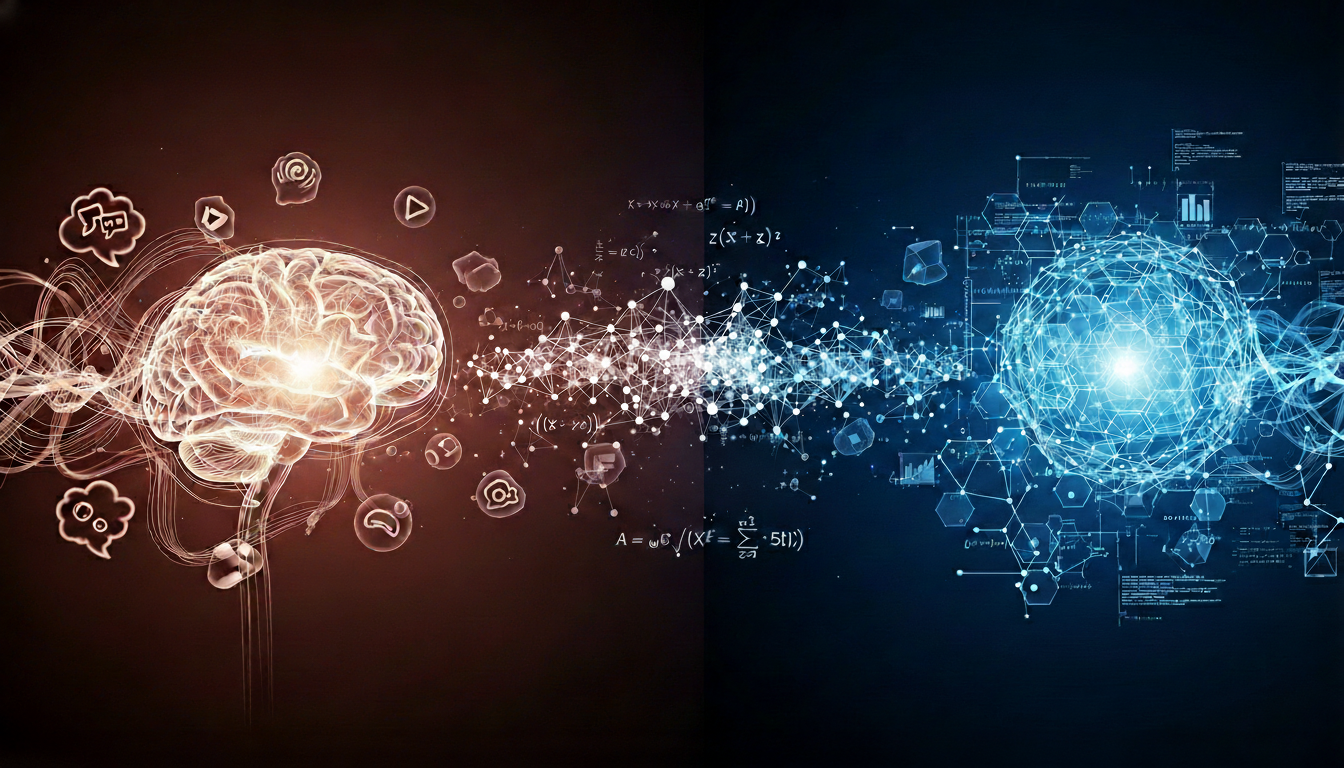
Human cognition and modern transformer-based language models appear radically different in their underlying substrates-biological mechanisms versus silicon architecture. However, recent research indicates that both systems operate according to the same fundamental computational principles: nonlinear weighted summation, competitive selection, predictive state propagation, and error-driven adaptation.
In this paper, we derive a Single Unified Master Equation (SUME) that captures the shared mathematical structure of biological neural computation and transformer-based prediction systems. We demonstrate that both systems instantiate a recursive predictive algorithm formalized as:
$$x_{t+1} = \sigma\big( W x_t + A(x_t) - \Theta \big)$$
This unified formulation models (1) membrane voltage thresholding and cortical predictive coding in the brain, and (2) transformer attention, softmax selection, and gradient descent in artificial models.
1. Introduction
The fields of neuroscience and machine learning have largely evolved independently. Biological brains operate via ionic conduction and action potentials, while modern artificial intelligence, particularly transformer models, relies on floating-point matrix multiplication and attention mechanisms executed on specialized hardware. Despite these profound differences in physical implementation, structurally similar computational motifs have emerged in both domains.
Both systems engage in predictive computation-a continual process of forming expectations, comparing those expectations to incoming sensory or data inputs, and updating internal states to minimize future errors.
Recent analyses highlight remarkable structural parallels:
- Weighted Input Integration: Neurons integrate weighted inputs through dendritic trees, analogous to the dot-product projections in transformers.
- Nonlinear Thresholding: The generation of action potentials acts as a nonlinear activation function, functionally equivalent to activations like ReLU or GELU.
- Competitive Selection: Lateral inhibition and cortical competition mirror the softmax selection mechanism used in attention heads and output layers, resolving ambiguity among potential outputs.
- Prediction-based State Evolution: The theory of predictive coding in the cortex corresponds closely to next-token prediction in language models, where both systems optimize internal models of expected sequences.
- Error-driven Weight Modification: Synaptic plasticity parallels gradient descent; both mechanisms modify connection weights based on prediction errors.
The convergence of these motifs suggests the existence of a deeper, underlying mathematical structure that unifies biological and artificial prediction. The goal of this white paper is to explicitly identify this structure, formalized as the Single Unified Master Equation (SUME), and explore its implications for the future of both neuroscience and AI.
2. Foundations of Biological Neural Computation
Biological neural networks process information through a combination of electrical and chemical signaling. The fundamental operations can be abstracted as follows:
2.1 Weighted Summation and Dendritic Integration
The primary stage of neural computation involves the integration of signals from upstream neurons. Dendritic integration computes a weighted sum of inputs, where the weights ($W$) represent synaptic strengths:
2.2 Nonlinear Thresholding and Action Potentials
Neurons maintain a resting membrane potential. When the integrated input ($u$) causes the membrane voltage to cross a specific threshold ($\theta$), the neuron generates an action potential (spike). This process is highly nonlinear:
Where $\sigma$ represents the nonlinear spike-generation function.
2.3 Competitive Dynamics and Lateral Inhibition
Neural circuits often exhibit competitive dynamics, most notably through lateral inhibition. In this mechanism, active neurons suppress the activity of their neighbors. This implements a form of winner-take-all selection, sharpening the neural representation and focusing resources on the most salient inputs:
2.4 Predictive Coding
A dominant theory in neuroscience posits that cortical circuits operate on the principle of predictive coding. The brain continually generates predictions of incoming sensory signals based on its internal model of the world:
2.5 Learning Through Synaptic Plasticity
The ability of the brain to learn and adapt relies on synaptic plasticity-the modification of the strength of connections between neurons. Weights are updated based on neural activity:
3. Foundations of Transformer Computation
Transformer models process sequences through a series of layers incorporating self-attention and feed-forward networks.
3.1 Linear Projections
The input sequence ($X$) is transformed through learned linear projections to create Query ($Q$), Key ($K$), and Value ($V$) matrices. These projections are analogous to the weighted summation in biological neurons:
3.2 Scaled Dot-Product Attention and Integration
The core innovation of the transformer is the self-attention mechanism. It calculates the relevance of different parts of the input sequence to each other. The softmax function acts as a competitive selection mechanism, normalizing the relevance scores into a probability distribution:
3.3 Nonlinear Update
The output of the attention layer is passed through a feed-forward network, which applies a nonlinear activation function ($\sigma$), typically GELU or ReLU, allowing the model to learn complex patterns:
4. The Single Unified Master Equation (SUME)
By comparing the computational operations in biological systems and transformer models, we observe a profound structural equivalence. Both systems are instantiations of a universal predictive recurrence process.
4.1 Unified State Evolution
The core of the SUME describes how the system state evolves from time $t$ to $t+1$:
Where the components are interpreted as:
- $W$ (Weights): Represents synaptic weight matrices in biology or learned linear projection matrices in transformers.
- $A(x_t)$ (Modulation): Represents dynamic modulation. In biology, this captures dendritic modulation and competitive inhibition. In transformers, this represents the attention mechanism.
- $\Theta$ (Threshold/Gating): Models biological firing thresholds or artificial gating/inhibition mechanisms.
- $\sigma$ (Activation): Represents the neuronal spike nonlinearity or the artificial activation function (e.g., GELU, ReLU).
4.2 Unified Weight Update Rule
The adaptation and learning mechanism in both systems is captured by the weight dynamics:
5. Mapping the Parallels
| Function | Human Brain (Biological) | Transformer Model (Artificial) |
|---|---|---|
| Weighted Sum | Dendritic integration | Linear projections (Q, K, V) |
| Nonlinearity | Spike threshold (Action Potential) | Activation functions (ReLU/GELU) |
| Competition | Lateral inhibition networks | Softmax function |
| Prediction | Cortical generative models | Next-token prediction |
| Error Correction | Sensory mismatch/Prediction error | Cross-entropy loss |
| Weight Updates | Synaptic plasticity (Hebbian) | Optimization (SGD/Adam) |
6. Conclusion
This white paper introduces the Single Unified Master Equation (SUME), demonstrating that human brains and transformer models implement the same predictive recurrence equation. The SUME formalism reveals that cognition-whether biological or artificial-is fundamentally the same mathematical operation instantiated on different substrates.
This unification bridges the gap between neuroscience and artificial intelligence, offering a principled foundation for building more biologically grounded AI architectures and providing a computational framework for understanding human predictive processing. The central insight is clear: prediction is a universal operation of intelligence, and the mathematical structures supporting it are conserved across biological and artificial systems.